
Soprano Titanium: how laser hair removal works
At First Wax we use the Soprano Titanium Special Edition by Alma Lasers. On this page you can see what happens in your skin: how the skin layers are built, how laser light turns into heat in the hair root and why the treatment is virtually painless thanks to gradual heating and continuous cooling.
- Wavelengths
- 755 · 810 · 1064
- Technology
- SHR In-Motion
- Cooling
- ICE Plus
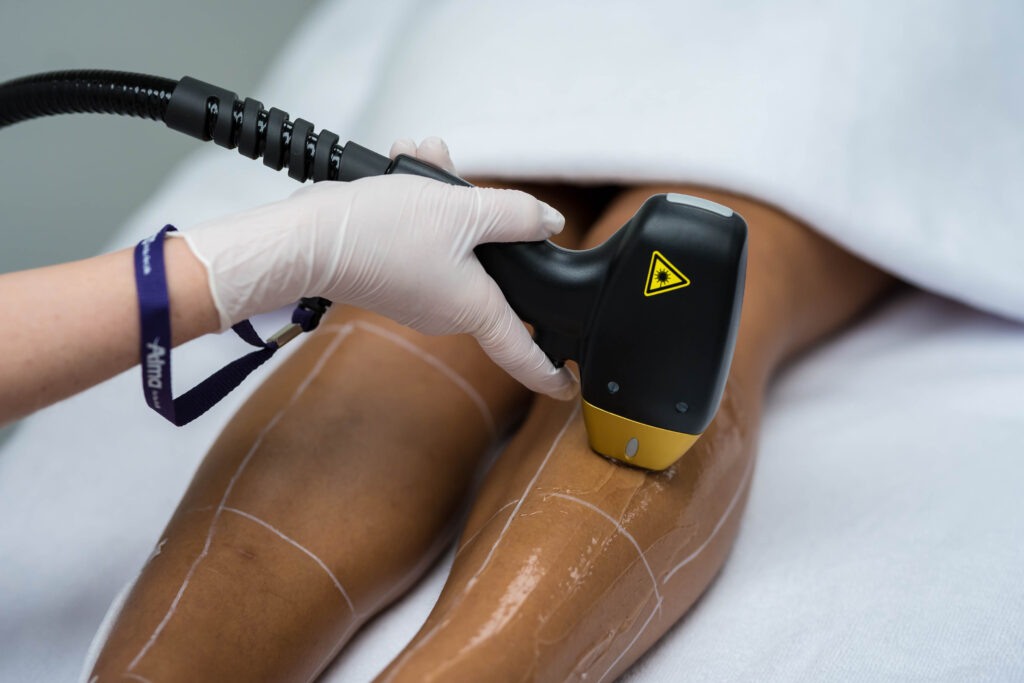
In short
- The laser heats the pigment in the hair root, so the follicle produces less and less hair.
- Three wavelengths (755, 810 and 1064 nm) reach both shallow and deep hair roots in one treatment.
- Gradual heating (SHR) and continuous cooling (ICE Plus) make it virtually painless: you mainly feel warmth.
- Usually six to ten sessions are needed, four to six weeks apart.
Three skin layers, one target: the hair root
Your skin consists of three layers. Hair grows from a follicle deep in the skin, and that is exactly where the heat of the laser needs to go.
- 1Epidermis, the protective outer layer
- 2Dermis (derma), the firm middle layer
- 3Subcutis (hypodermis), the fatty tissue
- 4Hair shaft, the visible part of the hair
- 5Hair follicle, the tube in which the hair grows
- 6Hair root (bulb) with dermal papilla, where the hair is made
- 7Sebaceous gland, which keeps hair and skin supple
- 8Sweat gland, which regulates body temperature
- 9Blood vessels, which feed the hair root
- 10Nerve endings, which sense heat and pain
- 11Melanin, the pigment that captures the laser light
Epidermis
Outer skin · epi = on, derma = skin
The thin outer layer, usually less than a millimetre. It also holds the pigment that determines your skin colour. Because that pigment also absorbs light, the Soprano cools this layer continuously.
Dermis
Derma · derma = skin
The thickest layer, made of collagen and elastin. In addition, this is where the hair follicles, blood vessels, glands and nerves sit. The laser works here, and this is where you feel warmth.
Subcutis
Hypodermis · hypo, sub = under
Fatty tissue that insulates and absorbs shocks. With thick hair, such as in the underarms and the bikini area, the hair root reaches down to here. That is what the 1064 nm wavelength is for.
What the Soprano Titanium does to the hair root
First, the laser light is absorbed by the dark pigment in the hair and turns into heat there. That heat disables the hair root, while the surrounding skin is spared. This is called selective photothermolysis.
This only works on hairs that are growing at that moment. Read how this determines the number of sessions in the hair growth cycle.
The three wavelengths of the Soprano Titanium
The longer the wavelength, the deeper the light reaches, so one wavelength is not enough. Hair roots are not equally deep everywhere, so the Soprano Titanium uses three at once.
755 nm · Alexandrite
The shortest wavelength and the most strongly absorbed by pigment. As a result, it works in the upper dermis, on finer and lighter hair with shallow roots.
810 nm · Diode
The middle wavelength, reaching medium depth in the dermis. So it treats the ordinary, medium-thick hair you see on legs, arms and back.
1064 nm · Nd:YAG
The longest wavelength, reaching down to the subcutis. Therefore it reaches thick hair with deep roots, such as in the underarms and the bikini area, and is absorbed least by the epidermis.
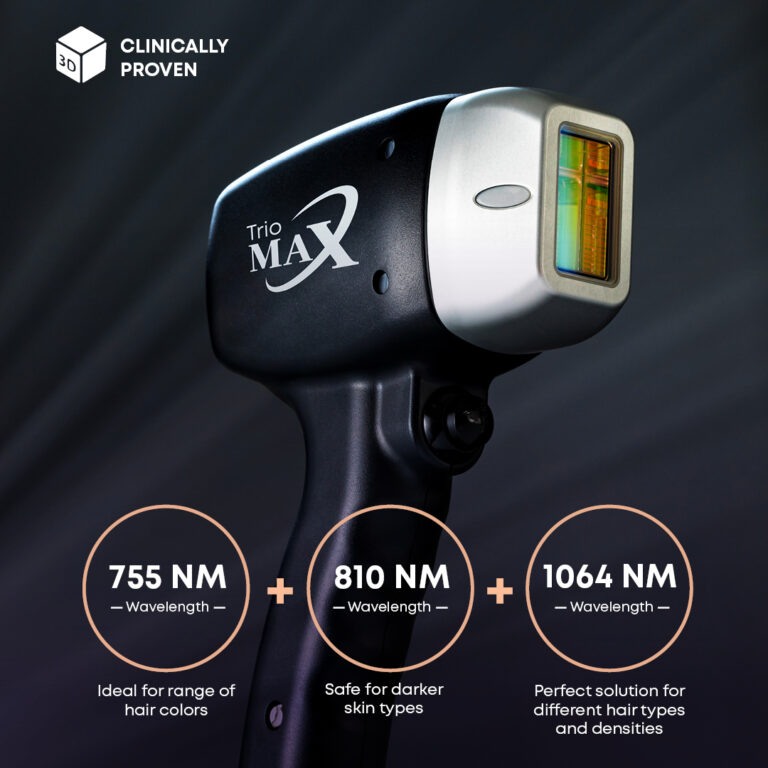
The Soprano Titanium Trio handpiece
However, many lasers work with a single wavelength. The Trio handpiece of the Soprano Titanium combines all three in one treatment head, so you do not need separate treatments per wavelength.
Large treatment head
For large areas, such as legs or back, we use a large treatment head. That keeps even a large area quick.
Tailored to you
Aleksandra, trained and certified by Alma Lasers, sets the power for each area to suit your skin and hair.
Want to know more?
You will find technical details on the Alma Lasers website, the manufacturer.
Laser hair removal with minimal pain
Most people only feel a warm, tingling glow. Still, feeling nothing at all is rare. The difference lies in how the heat is built up.
Why other lasers sting
Nerves in the dermis react to a sudden rise in temperature. A classic laser, however, heats the hair root in one powerful pulse. As a result, it feels like a rubber band snapping against the skin.
Why the Soprano feels different
The Soprano builds up the heat with many short pulses while the tip cools the skin. The hair root gets just as warm, but without a sudden spike. So you mainly feel warmth.
Gradual heating
SHR heats the hair root step by step, without a hard spike.
Continuous cooling
ICE Plus keeps the epidermis cool throughout the treatment.
Always moving
The handpiece glides over the skin, so the heat never lingers in one spot.
Tailored power
For each area, Aleksandra sets the power to suit your skin, hair and comfort.
What do you feel during a treatment?
At the start
First, you feel the cool tip on your skin, gliding over the area in calm passes.
During the treatment
Then the heat builds up to a warm, tingling glow. In areas with thick hair and thin skin, such as the bikini area, underarms and upper lip, you feel it a little more.
Afterwards
After that, your skin may still feel a little warm and look slightly red. This usually fades quickly, so you can carry on with your day straight away.
How to keep it as comfortable as possible
- Shave the area one to two days beforehand. Then the energy goes to the root and not to hair on the skin.
- Avoid the sun and sunbeds. Tanned skin absorbs more light and therefore feels the heat more strongly.
- Just say so if something feels too warm. Aleksandra adjusts the power per area.
- Around your period the skin can be more sensitive. If you prefer, plan your appointment at another time.
Warm in the root, cool on the surface
While the hair root heats up, the Soprano Titanium cools the epidermis continuously. The heat stays where it belongs: in the hair root. That is more comfortable and protects the skin.
Sapphire contact tip
That is because sapphire conducts cold very well. Therefore the cooled tip stays in contact with the skin during the treatment and draws heat away directly.
Protecting the epidermis
Because the epidermis stays cool, the pigment in the skin absorbs less heat. That reduces the chance of redness and irritation.
Calm for the nerves
In addition, cooled nerve endings react less strongly to heat. That makes sensitive areas, such as the bikini area and underarms, comfortable to treat.

The cooled sapphire tip
The photo shows the Trio handpiece of the Soprano Titanium. The clear window at the front is the sapphire tip. During the treatment it rests on the skin, cools continuously and lets the laser light through.
How is it different from IPL?
IPL is often mentioned in the same breath as laser, but it is a different technology. Most home devices also use IPL.
Laser (Soprano Titanium)
- Light
- Focused beam with fixed wavelengths
- Depth
- Precisely set per wavelength
- Skin types
- Light to dark
- Feeling
- Gradually warm, cooled
IPL (flash lamp)
- Light
- Broad spectrum, filtered
- Depth
- Energy more spread out
- Skin types
- Mainly light skin
- Feeling
- Sharp flash per spot
Laser hair removal glossary
A short explanation of the terms you come across on this page and during your intake.
- Epidermis outer skin
- The outermost skin layer. From the Greek epi (on) and derma (skin).
- Dermis derma
- The middle skin layer with hair follicles, blood vessels, glands and nerves.
- Hypodermis subcutis
- The deepest layer, mainly fatty tissue. Hypo and sub mean under.
- Hair follicle
- The small tube in the skin in which a hair grows.
- Dermal papilla
- The small knob at the base of the hair root that feeds the growing hair through blood vessels.
- Melanin
- The pigment that gives hair and skin their colour. In the hair it captures the laser light.
- Anagen phase growth phase
- The phase in which the hair grows actively and the laser works best.
- Wavelength nm
- The colour of the laser light, expressed in nanometres. A longer wavelength penetrates deeper.
- Selective photothermolysis
- The principle by which light heats only a chosen target, here the pigment in the hair.
- Fluence
- The amount of energy per square centimetre of skin.
- SHR
- The Alma Lasers technology that heats the hair root gradually with many short pulses.
- In-Motion
- The technique in which the handpiece glides continuously over the skin.
- ICE Plus
- The cooling system of the Soprano Titanium, with a cooled sapphire tip.
- Alexandrite, diode and Nd:YAG
- The three laser types behind the 755, 810 and 1064 nm wavelengths.
Questions about the Soprano Titanium
Is laser hair removal with the Soprano Titanium painful?
Most people feel a warm, tingling glow and find it very manageable. That is because SHR heats the hair root gradually and ICE Plus keeps the epidermis cool. Feeling nothing at all is rare, and in areas with thick hair you feel a little more.
Do I need a numbing cream?
With the Soprano Titanium this is usually not necessary. Please do not use a cream on your own initiative, but discuss it with Aleksandra first.
Where do you feel laser hair removal the most?
In areas with thick, dark hair and thin skin, such as the bikini area, underarms and upper lip. There is more pigment there, so more heat is created. We adjust the power per area.
What is SHR?
SHR is the Alma Lasers technology in which the laser heats the hair root gradually with many short pulses, instead of one powerful pulse. Together with the cooling, this makes the treatment comfortable.
Why do I need to shave the area beforehand?
Hair above the skin would absorb the laser energy at the surface. After shaving, the energy travels through the hair in the skin straight to the hair root, where it is needed.
Why are three wavelengths better than one?
Hair roots sit at different depths and hair varies in thickness. With 755, 810 and 1064 nm at once, we reach both shallow and deep hair roots in one treatment.
Is laser the same as IPL?
No. A laser emits focused light with fixed wavelengths, while IPL is a flash lamp with a broad spectrum of light. That makes laser energy easier to direct at the hair root.
Is the Soprano Titanium safe?
The Soprano Titanium is CE certified and used in clinics worldwide. In addition, every course of treatments at First Wax starts with an intake and a skin test.
Would you like to know what a treatment costs or how a course works? See the laser hair removal page or the price list.

Want to experience the Soprano Titanium?
Booking is temporarily not possible. In early November we will email our clients to let them know when you can book again, including a free trial treatment. Until then, we are happy to answer your questions on WhatsApp.